
How to Move Your Family to the US (Family-Based Immigration)
Bringing your family to the United States is an important milestone, but the immigration process can often feel overwhelming. United States citizens and lawful permanent residents may be eligible to sponsor certain family members for permanent residence, to obtain a green card, through the family-based immigration system.
Sponsoring a family member for a green card requires the petitioner to satisfy several legal requirements before the beneficiary may receive immigration benefits. Eligibility, processing times, and available options vary depending on the relationship between the parties and the petitioner’s immigration status.
The information below provides an overview of the general requirements and process for sponsoring family members for permanent residence.
If you are seeking to bring a foreign fiancé(e) to the United States, the process differs a little bit.
Types of Family Petitions
There are several types of family-based petitions available under United States immigration law. Determining which category applies to your situation is an important first step in the process and can help set realistic expectations for eligibility and processing times.
The appropriate petition depends largely on the petitioner’s immigration status and their relationship to the beneficiary. Family-based petitions generally fall into two categories: petitions for immediate relatives and petitions within the family preference categories.
Immediate Relatives
Under this category, US citizens may sponsor certain close family members for permanent residence in the United States. Unlike other family-based immigration categories, there are no annual numerical limits on the number of immigrant visas available for immediate relatives.
The immediate relative category includes:
- spouses (IR-1/CR-1);
- children under the age of 21 (IR-2/CR-2); and
- parents (IR-5).
Family Preference Categories
United States citizens and lawful permanent residents may also sponsor certain relatives who do not qualify as immediate relatives. Unlike the immediate relative category, immigrant visas available under the family preference categories are subject to annual numerical limits or caps.
Because the number of applicants often exceeds the number of visas available, processing times under these categories can be lengthy. Depending on the category and country of chargeability, applicants may wait several years before a visa becomes available.
The family preference categories include:
- a US citizen’s unmarried children over the age of 21 (FB-1);
- a lawful permanent resident’s spouse and any children under the age of 21 (FB-2A);
- a lawful permanent resident’s unmarried children over the age of 21 (FB-2B);
- a US citizen’s married children (FB-3);
- a US citizen’s siblings (FB-4).
Fiancé(e) Petitions
US citizens may also petition for their foreign fiancé(e) by applying for a K-1 visa. This process slightly differs from the other family-based categories.
Family petitioners typically file form I-130 for their relatives. If the petitioner is filing for their fiancé(e), they file a I-129F.
The K-1 visa also has additional requirements. A K-1 visa requires both parties to prove that they are legally free to marry. They are also required to show that they met in-person at least once within the last two years before filing. Finally, they must demonstrate an intent to marry one another within 90 days after the fiancé(e) arrives and admitted into the US.
In order to bring the fiancé(e)’s children, the petitioner must apply for a K-2 visa.
Process
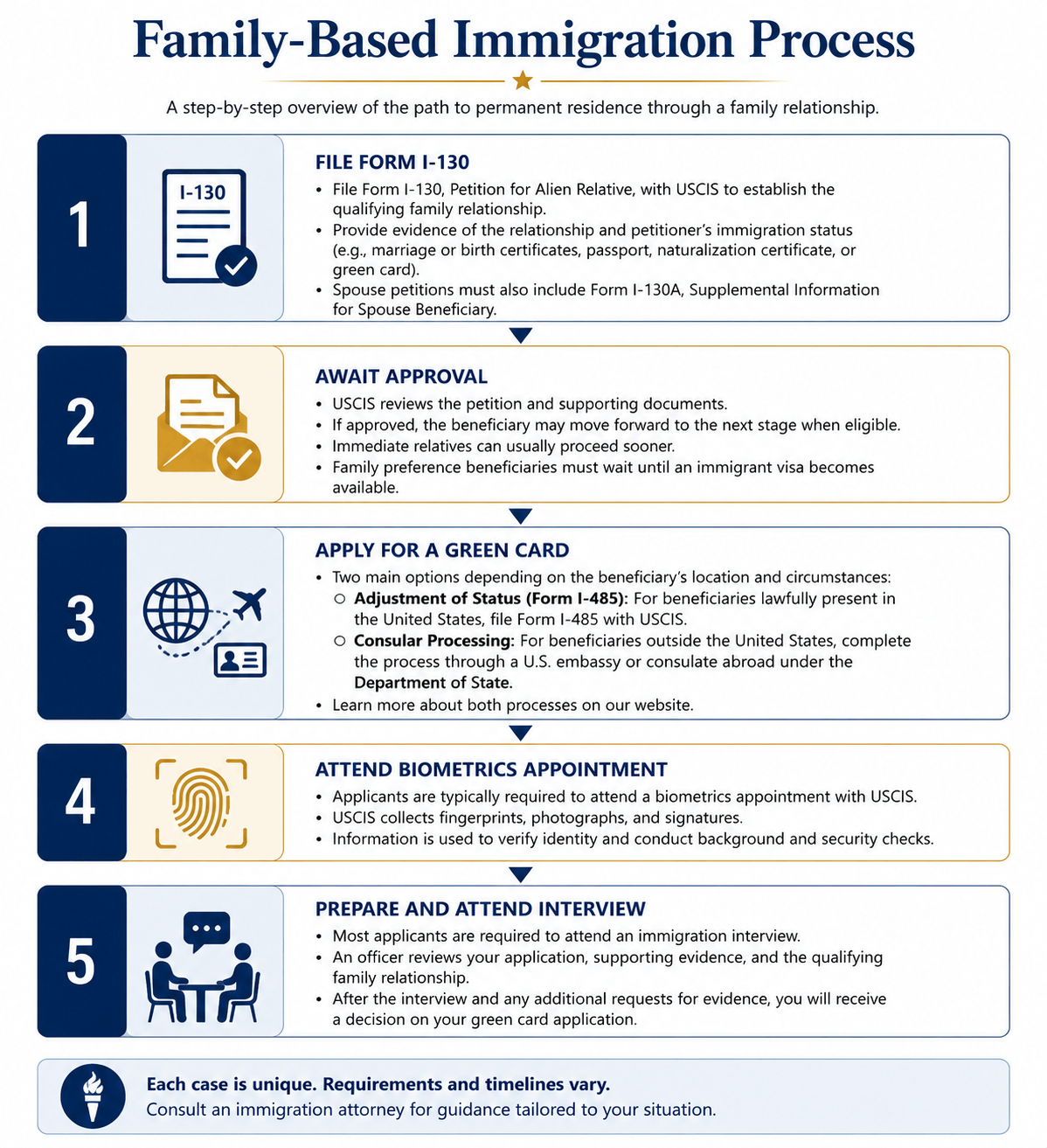
Step 1—File form I-130
The family-based immigration process generally begins with filing Form I-130, Petition for Alien Relative, with the U.S. Citizenship and Immigration Services (USCIS). The purpose of the petition is to establish the qualifying relationship between the petitioner and beneficiary.
Petitioners must provide evidence of both the family relationship and their own immigration status. Depending on the case, this may include marriage certificates, birth certificates, passports, naturalization certificates, or permanent resident cards. Petitioners sponsoring a spouse must also submit Form I-130A, Supplemental Information for Spouse Beneficiary.
Step 2—Await Approval
After filing Form I-130, USCIS will review the petition and supporting documentation. If the petition is approved, the beneficiary may proceed with the next stage of the immigration process when eligible to do so.
For immediate relatives, the next step is often available sooner. Beneficiaries in the family preference categories need to wait until an immigrant visa becomes available before continuing.
Step 3—Applying for a Green Card
There are generally two ways to apply for permanent residence, and the appropriate process depends on the beneficiary’s location and circumstances.
Beneficiaries who are lawfully present in the United States may be eligible to apply for permanent residence through Adjustment of Status by filing Form I-485 with USCIS.
Beneficiaries residing outside the United States generally complete Consular Processing through a United States embassy or consulate abroad under the supervision of the Department of State. Click here for more information about adjustment of status and consular processing.
Step 4—Attend Biometrics Appointment
Applicants are typically required to attend a biometrics appointment with USCIS. During this appointment, USCIS collects fingerprints, photographs, and signatures to verify identity and conduct background and security checks.
Step 5—Prepare and Attend Interview
Most applicants are required to attend an immigration interview as part of the green card process. During the interview, an immigration officer may review the application, supporting evidence, and the qualifying family relationship.
Following the interview and completion of any additional requests for evidence, you will receive a decision regarding the application for permanent residence.